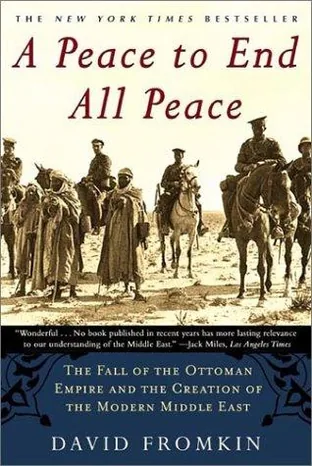
A Peace to End All Peace: The Fall of the Ottoman Empire and the Creation of the Modern Middle East
A narrative history of how the Ottoman Empire fell and the modern Middle East was invented, largely at British desks, between 1914 and 1922: the wartime bargains and postwar settlement that produced Iraq, Jordan, Lebanon, Syria, and the Palestine mandate. Finalist for the Pulitzer Prize in General Nonfiction and the National Book Critics Circle Award. Page count is the standard in-print edition: Holt Paperbacks 20th Anniversary Edition (2009, ISBN 9780805088090), 688 pages with Fromkin's new afterword; the 1989 Holt hardcover runs 635 pages.
Somewhere past page 400 it sinks in that you are reading about London, not the Middle East. "The problem is how British centred this is. You don't really get nearly enough of a perspective even from other European nations," one reader writes, and Arabs and Turks fare worse, appearing mostly as items in Whitehall's paperwork. Fromkin waves the Arab Revolt off as occurring "not so much in reality as in the wonderful imagination of T. E. Lawrence," a dismissal critics answer with Liddell Hart's account of Arab military contributions. And the cast swells past remembering: "much of the information contained in A Peace to End All Peace went in one eye and out the other," admits a reader who "never had a good picture of where things were happening."
The case for it and the rest of the canon open with Pro.