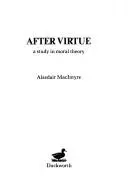
After Virtue
Decide its fate
The record
Time
An eveningA season286 pages, about 6 hours: four-fifths the length of a typical book on the shelf.
Getting in
Walk right inSteep climbThe opening imagines the natural sciences destroyed by catastrophe and rebuilt from surviving fragments without their original theories.
What it gives
Plot and actionIdeas to live byIn 12 reviews from critics and book blogs, none credit the plot and 12 credit the ideas or a change in how they live.
One of a kind
Others do thisNothing else doesTwo 2021 blog posts compare it to C.S. Lewis’s The Abolition of Man, published decades earlier on the same subject.
The case for it
on the prose
“After Virtue is a striking work. It is clearly written and readable.”
J.M. Cameron · The New York Review of Books, 1981 on emotivism in politics
“Emotivism helps explain how politicians deploy saccharine moral language to equivocate and disguise ideological agendas”
a book blog on MacIntyre’s lectures
“the book does read as if you were sitting in on one of MacIntyre’s lectures.”
a book blog on the opening metaphor
“the beginning of the book is a fascinating and attractive metaphor”
a book blog
The case against
on the style
“Most of the book is dry and highly technical”
a book blog on the virtue account
“the account of the virtues doesn’t necessarily solve the question of moral incommensurability”
a book blog on the Kierkegaard chapter
“One of the few sour notes in After Virtue is MacIntyre’s interpretation of Søren Kierkegaard.”
a Substack review on the opening hypothesis
“The hypothesis is thus on its way to being difficult if not impossible to falsify”
a Substack review