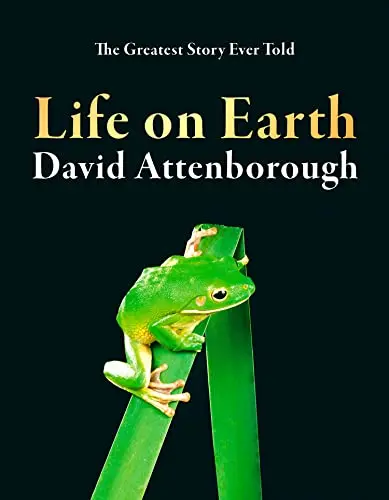
Life on Earth: A Natural History
Attenborough walks the evolutionary story forward across thirteen chapters, opening not at the beginning but on the puzzle of abundance: Darwin in a Brazilian forest in 1832, sixty-eight species of beetle collected in a single day. From there he works back to the first single-celled life and the stromatolites of Shark Bay, then forward through invertebrates, fish, amphibians, reptiles, birds and mammals to a closing chapter on humans, “The Compulsive Communicators.” Because the fossils are silent, he reads living stand-ins he had filmed: horseshoe crabs, the coelacanth, lungfish, the tuatara. It was the companion volume to the thirteen-part BBC series he wrote and presented in 1979, and the chapters track the episodes.
Kate Savage gave it four stars and still filleted it: “all females are described in passive terms, all males in active.” When agriculture gets invented, the inventing happens in male pronouns while the women gather. The biology has aged worse than the pronouns. Savage flags the material “on the evolution of bacteria, archaeobacteria, algae, fungus, and protists” as what “would be considered out-of-date,” which is exactly where nearly fifty years of molecular phylogeny have landed hardest. Breadth costs depth as well: birds get dispatched in about thirty pages and the dinosaurs never get a chapter of their own, leaving one reviewer with “a rapid flit through its subject.” Others found it “dry,” like “ticking off a checklist” next to the documentaries.
The case for it and the rest of the canon open with Pro.