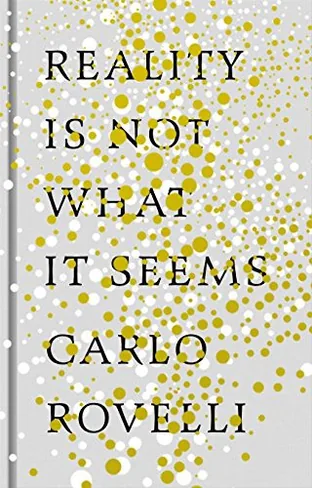
Reality Is Not What It Seems: The Journey to Quantum Gravity
Carlo Rovelli traces the idea that matter and space are granular from the Greek atomists through Newton, Faraday, Einstein and quantum field theory, arriving at loop quantum gravity, the research program he helped found. The book argues that space is made of discrete quanta and that time is not fundamental.
Only 20 to 30 percent of this book is quantum gravity, by one reader's count, and the rest goes to "pre-Einsteinian high school physics," so the theory chapters, when they finally arrive, read like a pitch. "If loop quantum gravity were as obvious to physicists and as complete as it's presented, it would be quantum gravity solved and no one would be bothering about string theory," writes a reader who noticed the rival gets a passing mention. Even an admirer calls the exposition "broad and simplified" and a "sell job" that skips "problematic issues like computation and self-consistency checks." The history gets bent to fit the same story: told that Galileo was the first experimenter, one reader asks, "what of William Gilbert or the medieval optical experiments, for example?"
The case for it and the rest of the canon open with Pro.