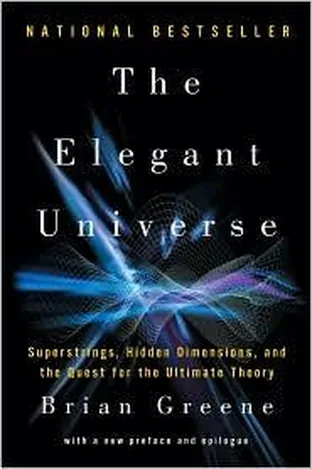
The Elegant Universe: Superstrings, Hidden Dimensions, and the Quest for the Ultimate Theory
A popular-science account of string theory by Columbia physicist Brian Greene, walking lay readers from special relativity and quantum mechanics to the proposal that tiny vibrating strings in eleven dimensions could unify all of physics. First published by W. W. Norton in February 1999, it was a Pulitzer Prize finalist and the book that made string theory a household phrase.
Those early chapters are bait. You put in the work on relativity and quantum mechanics, then "about half-way through the text, it devolves into (what feels like) a navel-gazing vanity project that fails to connect that promising strategy with the target audience." Where the theory hits trouble, Greene vaults: one reviewer counts "far too many places where the solution to problems within the theory appear to be solved by the 'with one giant leap our hero escapes' methodology favoured by Flash Gordon short films from the 1930's." Then the LHC found none of the predicted supersymmetric particles, so string theory "rarely if ever gives you that feeling you get from good science," and one reader groans, "To think I put all that effort to understand a discredited theory..."
The case for it and the rest of the canon open with Pro.