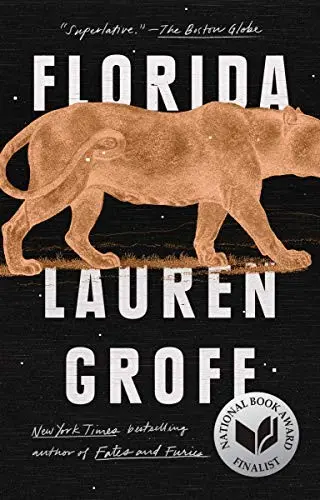
Florida
Story Prize winner, 2018. Groff's stories of Florida (its beauty and its rot, its women surviving and failing, its weather as moral condition) announced a new major voice in American short fiction. Where her novels are vast, these stories are concentrated and venomous.
The last and longest story, about a mother researching Guy de Maupassant in France with her two sons, is repeatedly called the weakest link, one reader noting flatly that “the only story about a novelist proved to be the weakest.” More than one reviewer says the male characters get flattened into absent, inept, or predatory types, and calls the pattern heavy-handed, with one reader going further: “the anti-male propaganda was over the top.” Some readers find the prose overwritten, pointing to long enumerations of grocery items and clutter they read as padding rather than atmosphere. Several reviewers admit the stories blur together afterward, and despite admiring individual sentences, say “finished this collection and I can barely recount any of them.” A recurring complaint holds that mood carries the book while plot stays thin, which one reader sums up bluntly: “too much atmosphere and not enough substance for my taste.”
The case for it and the rest of the canon open with Pro.