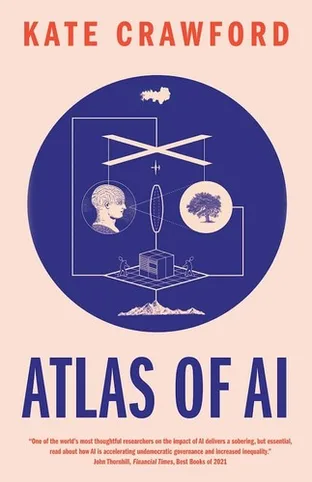
Atlas of AI: Power, Politics, and the Planetary Costs of Artificial Intelligence
Decide its fate
Clever Hans, the arithmetic horse who was really reading his trainer's posture, does the demolition work here: the book, one reader writes, "uses the Clever Hans Effect to critique claims of AI intelligence, neutrality, or autonomy." What follows is geography: mines, Amazon warehouse floors, scraped datasets, emotion scores, military contracts, one supply chain. Another reader quotes the book itself: "we should think of the skyscrapers of San Francisco as inverted minescapes," extraction pointed upward instead of down. No technical background needed: "This is a great book for readers (like me) who don't even know how the cloud works." Then the closing pages on tech billionaires and their plans for leaving Earth, "the haunting coda that elevates the already important book to the classic of 21st century."
Six chapters, one maneuver: mining, then warehouses, then datasets, then categories, each pronounced extractive. "Each chapter felt the same, just with different bad actors," one reader writes, and the repetition wears down even a reviewer working in AI who shares the book's ethics. The reason: much of it is a critique of capitalism, not AI, and "she barely even tries to make most of it relevant to AI, and the strident scolding tone makes it feel like the airing of grievances." Her most damning case, Michigan's unemployment algorithm, arrives stripped of scale: "we get no data on total numbers of people evaluated, or percentage of errors." And for anyone reading now: "this book was published in Spring 2021 and ChatGPT was not publicly released until November 2022."