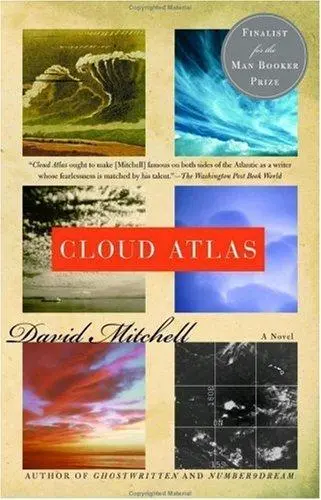
Cloud Atlas
Decide its fate
The record
Time
An eveningA season537 pages, about 11 hours: the length of 1.7 typical books on the shelf.
Getting in
Walk right inSteep climbTwo readers report struggling through Adam Ewing’s opening Pacific journal before the book wins them back.
What it gives
Plot and actionIdeas to live byIn 17 reviews from critics and book blogs, 5 credit the plot and 9 credit the ideas or a change in how they live.
One of a kind
Others do thisNothing else doesA blog says Mitchell attempts Calvino’s device in If on a Winter’s Night a Traveler, on the shelf at 260 pages, without matching it.
The case for it
on the six styles
“Cloud Atlas likewise jumps in and out of half a dozen different styles”
Jeff Turrentine · The Washington Post, 2004 on Robert Frobisher
“nailing the tones of the dissolute composer/amanuensis Robert Frobisher”
a book blog on Cavendish’s escape
“the Cavendish ordeal that I most enjoyed was when Cavendish escapes with 3 others”
a book blog on Sonmi’s story
“part of the book, it gave me strong vibes of Blade Runner and Nineteen Eighty-Four”
a book blog
The case against
on Zachry’s pidgin
“The pidgin English Mitchell used to write it was really hard to read quickly”
two stars · a book blog on the length
“I was counting down the pages until I reached the end”
a book blog on some sections
“a couple devolve to the pedestrian, marring the overall effect of the novel”
Art Winslow · The Chicago Tribune, 2004 on Ewing and Zachry
“I found Story 1 and 6 a little hard to follow because they’re written differently”
five stars · a Substack review