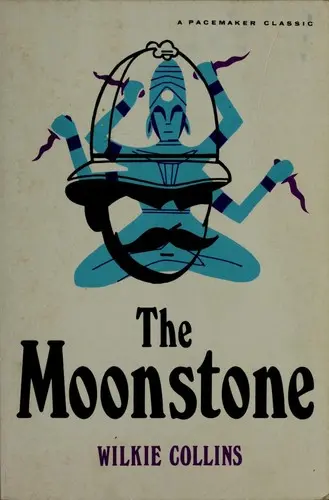
The Moonstone
Decide its fate
The record
Time
An eveningA season448 pages, about 9 hours: the length of 1.4 typical books on the shelf.
Getting in
Walk right inSteep climbTwo readers report needing extra effort before the diamond disappears; one counts ninety pages to that point.
What it gives
Plot and actionIdeas to live byIn 11 reviews from critics and book blogs, 8 credit the plot and 7 credit the ideas or a change in how they live.
One of a kind
Others do thisNothing else doesTwo book blogs and Five Books weigh it against Collins’s own The Woman in White, on the shelf at 544 pages.
The case for it
on the genre
“The Moonstone is the first and greatest of English detective novels. We say English detective novels, because there is also the work of Poe, which has a pure detective interest.”
T. S. Eliot · “Wilkie Collins and Dickens,” 1927 on Miss Clack
“who believes herself to be quite pious but just can’t refrain from catty comments”
a book blog on Sergeant Cuff
“it introduces Sergeant Cuff, a memorable literary detective”
Jason Hall · Five Books, 2016 on Gabriel Betteredge
“He is both an astute and often hilarious narrator.”
a book blog
The case against
on the length
“482 pages of dense type, with footnotes”
a book blog on Miss Clack’s prose
“Miss Clack’s prose is rather turgid and overly formal”
a book blog on the diamond
“I was disappointed the eponymous moonstone didn’t have more to do with the plot”
three stars · a Substack review on the pacing
“plot lines are tidied up too hastily”
a book blog