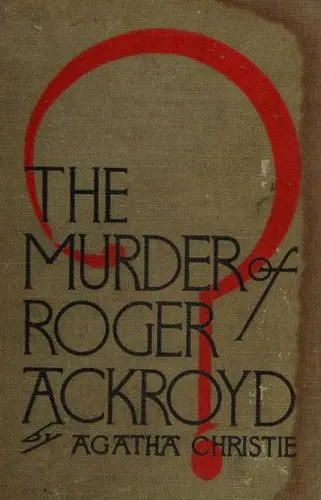
The Murder of Roger Ackroyd
Decide its fate
The record
Time
An eveningA season71,007 words, 4.7 hours at 250 words a minute: four-fifths the length of a typical book on the shelf.
Getting in
Walk right inSteep climbThe first three chapters are village gossip and Poirot’s vegetable marrows; the body is found in chapter five, a sixth of the way in.
What it gives
Plot and actionIdeas to live byIn the first 30 Goodreads reviews, 21 credit the plot and none the ideas or a change in how they live.
One of a kind
Others do thisNothing else doesIt is the shelf’s only Christie; three readers rate Murder on the Orient Express or And Then There Were None higher.
The case for it
on the construction
“Not that any ‘Sherlock Holmes’ glamour surrounding the figure of Hercule Poirot makes her present story as good as it is. Poirot is merely one factor in a tale so ingeniously constructed, so dextrously plotted as to warrant our complete admiration.”
William Rose Benét · The Saturday Review of Literature, 24 July 1926 on Poirot’s entrance
“My favorite part of the book is when Poirot makes his grand entrance.”
five stars · Goodreads on Caroline Sheppard
“nosy gossip of a sister, Caroline Sheppard, with her constant random theorising, is most entertaining”
four stars · Goodreads on the village
“From the first page I dived into a ‘murder in a small English town’ atmosphere”
four stars · Goodreads
The case against
on the thrills
“There are doubtless many detective stories more exciting and blood-curdling than ‘The Murder of Roger Ackroyd,’ but this reviewer has recently read very few which provide greater analytical stimulation. This story, though it is inferior to them at their best, is in the tradition of Poe’s analytical tales and the Sherlock Holmes stories.”
unsigned review · The New York Times Book Review, 18 July 1926 on Poirot’s mannerisms
“I must space them out so that his mannerisms and humor do not stale”
four stars · Goodreads on period attitudes
“It is a fun ride that does have some rather unfortunate rampant misogyny”
four stars · Goodreads on the Mah Jong evening
“a few unnecessary scenes which made the book longer than was needed”
four and a half stars · a book blog