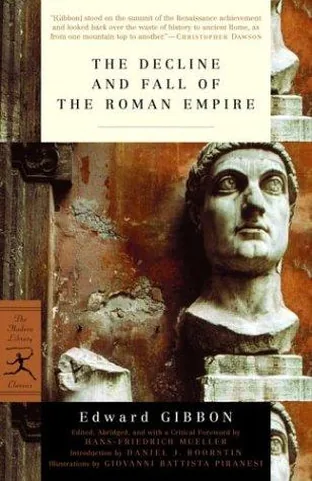
The History of the Decline and Fall of the Roman Empire
Gibbon's six-volume history, published 1776-1788, traces the Roman Empire from the height of the Antonines through the fall of Constantinople in 1453, covering roughly thirteen centuries of political, military, and religious history. It is widely treated as the founding work of modern historical writing in English, famous as much for its ironic prose as for its argument. Page count is the complete Penguin Classics three-volume boxed set edited by David Womersley (1232 + 1024 + 1360 pages).
Six volumes. Over three thousand six hundred pages in the complete set, and one finisher's verdict on the whole trek: "a hellish and a pointless slog." Even a reader who stuck it out through three volumes admits "this one was really heavy going." And the miles buy you eighteenth-century scholarship: text-only history, written before archaeology existed as a discipline, its famous thesis about Christianity contested ever since rather than confirmed. The second half is worse, because "Gibbon hated the Byzantines, thought they were appallingly religious" (this from a reviewer who mostly liked the book), and he "portrays the medieval eastern Romans through a negative, Orientalist lens as essentially backwards, superstitious, unenlightened, and stagnant."
The case for it and the rest of the canon open with Pro.