At the Existentialist Café
Decide its fate
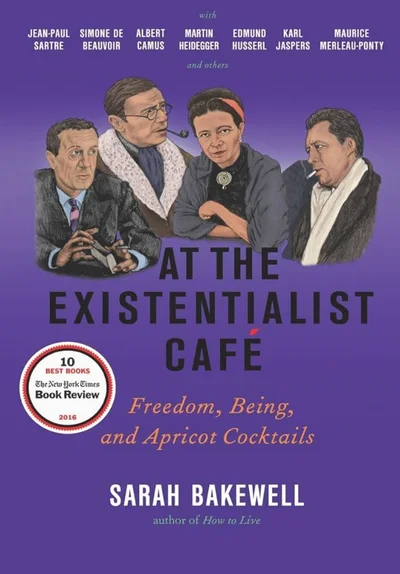
Three friends over apricot cocktails in 1933, and Aron points at his glass and tells Sartre you can make philosophy out of that. Bakewell builds the movement out from there, one chapter per thinker, and readers who could not get through Sartre or Heidegger directly say “Bakewell's deft touch makes the turgidities of philosophy dissipate like fog” and they came away with a real grasp anyway. The rescue of Husserl's manuscripts from Nazi Germany reads as “pure cloak and dagger.” She keeps the failures in rather than around them, Heidegger's Nazism especially, and readers call the result “not just Baby's First Sartre.” The Sartre and Camus split on freedom is the clearest line running through it.
The cast is large, Husserl and Heidegger and Jaspers and Merleau-Ponty alongside the famous three, and no one gets sustained depth. Readers finish knowing the biographies well and still feel unequipped to open Being and Nothingness, and one reviewer put the disappointment in blunt terms: “wasn't fully equipped to engage with a multi-subject biography.” The harshest complaint dismisses the philosophy itself, one reader concluding “phenomenology is stupid... not philosophy” and faulting the book for not pushing back on that vagueness. Bakewell's sympathy for Sartre strikes a few as generous given his record, especially measured against her Camus, and readers wanted Beauvoir's own philosophy rather than Beauvoir mostly in relation to him.