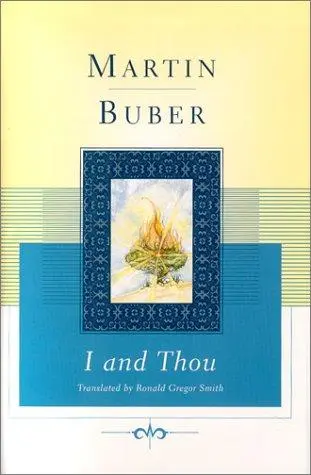
I and Thou
Decide its fate
The record
Time
An eveningA season119 pages, about 2 hours: half the length of a typical book on the shelf.
Getting in
Walk right inSteep climbOne reader reports giving up on a book that opens by setting out Buber’s two primary words, I-Thou and I-It.
What it gives
Plot and actionIdeas to live byIn 13 reviews from critics and book blogs, none credit the plot and 8 credit the ideas or a change in how they live.
One of a kind
Others do thisNothing else doesAeon groups it with Montaigne’s essays and Camus’s The Myth of Sisyphus as philosophy general readers enjoy.
The case for it
on the lyricism
“I and Thou is a slim book, marked by flights of heartfelt lyricism”
M. M. Owen · Aeon, 2018 on the Smith translation
“I and Thou, translated by Ronald Gregor Smith, is a sublime read in its entirety.”
Maria Popova · The Marginalian, 2018 on Kaufmann’s prologue
“Kaufmann’s prologue and notes, and Buber’s afterword, were still very helpful in clarifying the ideas”
a book blog on the self in address
“Buber argues that my own self is constituted by the way I address the other.”
Yemima Hadad · quoted in JNS, 2023
The case against
on the language
“tends to blur all contours in the twilight of suggestive but extremely unclear language”
Walter Kaufmann · prologue to his translation of I and Thou, 1970 on the 61 sections
“I and Thou is really more of a loose collection of 61 aphorisms.”
a book blog on the third part
“I found this part of the book the most difficult to follow”
a book blog on the prose
“Stripped of all the obtuse language, repetition and other kerfluffle”
a book blog