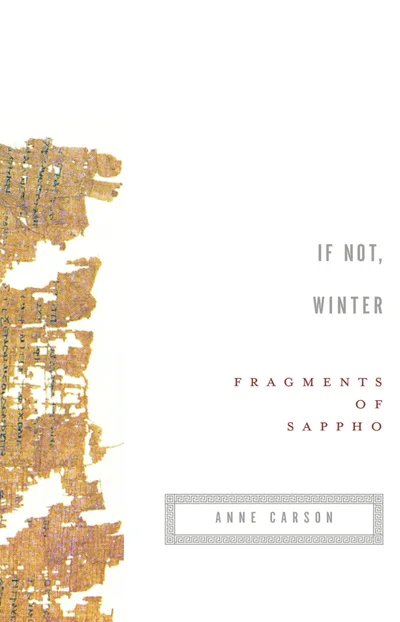
If Not, Winter: Fragments of Sappho
The definitive modern translation of Sappho. Carson presents every surviving fragment with the gaps marked as brackets, making the incompleteness itself a form of meaning. Reading "[ ] / [ ] / [ ] desire" is to feel both what Sappho wrote and what time has destroyed. Carson's decision to present the fragments as fragments transformed translation into an original act of poetics. The most beautiful translation of the 20th century.
A serious critic dissents from the consensus, arguing many of these translations “sound more like trots than fully achieved poems,” the same fidelity to the Greek that other reviewers praise treated here as a cost paid in poetic achievement. One reader working straight through records real irritation, not with Sappho but with the translator: “I'm loving Sappho's poetry immensely, but Anne Carson is pissing me off.” The book runs past four hundred pages once the facing Greek, notes, and apparatus are counted, far more than the slim 'poems' framing suggests; one reader was still only at page 121. Fragment 102 gets flagged as a flashpoint, Carson's choice to translate a term as boy rather than girl or youth the kind of small call that invites second-guessing. The bracket-heavy layout resists being read as a conventional collection front to back.
The case for it and the rest of the canon open with Pro.