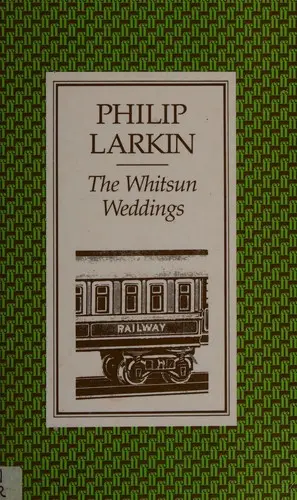
The Whitsun Weddings
The collection that confirmed Larkin as the central English poet of the postwar era, and perhaps the most read English poet of the 20th century after Eliot. His subjects are time, disappointment, England's gradual fade, sex's awkwardness, death's absolute certainty, all rendered in stanzas of such formal perfection that the bleakness becomes oddly consoling. "An Arundel Tomb" ends: "What will survive of us is love." Even Larkin couldn't help believing it.
Larkin himself, not the poems, draws the sharpest complaints here: readers who know his off-page reputation, documented misogyny, general nastiness in his letters and biography, say it curdles their reading even when they admire individual poems. “Horrible man who wrote some decent poems” is how one reader splits the difference, and another cuts straighter: “i hate philip larkin.” The consistent bleakness wears on some readers too, and at least one flags a specific rhyme, Larkin pairing “kind” with “unkind,” as evidence the collection isn't uniformly polished. A companion York Notes study guide draws its own separate complaint, strong on historical and biographical background but, as one critic put it, “GOOD ON BACKGROUND, BLAND ON THE POEMS.”
The case for it and the rest of the canon open with Pro.