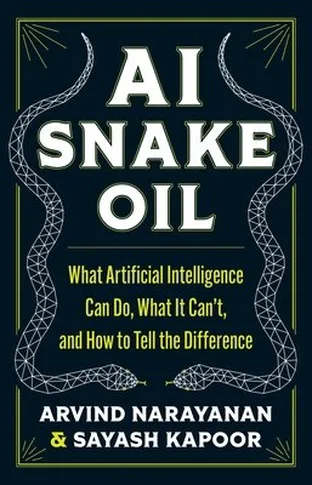
AI Snake Oil: What Artificial Intelligence Can Do, What It Can't, and How to Tell the Difference
Decide its fate
Split the word before you fight about it: predictive, generative, content moderation, three technologies that behave nothing alike, and once the book pries them apart you can finally tell which argument you are actually in. Predictive AI takes the hardest beating, bail algorithms and hiring screens that barely outdo a coin toss while applicants game them anyway: they "stuff their resumes with keywords from the job application and add the names of top universities in white text." "Much-needed cold water poured on AI hype," writes one reader who counted 489 citations, nearly two a page. An AI researcher calls it "the most balanced and reasonable take on AI I've encountered (including my own)," and a reviewer at odds with its politics still insists the existential-threat chapter "should be widely read."
Two AI researchers wrote a book warning about hype, and it reads, per one reviewer, "exactly like the product of a good model and a solid prompt": repetitive chapter summaries, restatement on restatement, a magazine argument inflated to 360 pages. The taxonomy can't even hold the table of contents together, "shoe-horning a chapter about social media business models" into a book about data modeling. It skips AI's power and water bills almost entirely, and the election chapter leans on one narrow slice of deepfake counts, so "the authors do the very thing they charge AI snake oil hype with." The facts wobble: the claim that "elevator operator as a career no longer exists because of automation" (it does), and an assurance nobody would draft an email with ChatGPT, already antique.