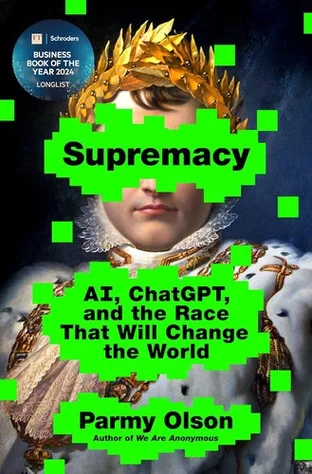
Supremacy: AI, ChatGPT, and the Race that Will Change the World
Decide its fate
Start with what Google did to its own invention: company researchers built the transformer architecture behind ChatGPT back in 2017, then buried it rather than endanger the search-ads billions. One reader draws the lesson: "monopolies don't necessarily innovate; they protect their profits." Olson threads that reveal through a dual biography in which "Hassabis and Altman fairly leap off the page," a chess prodigy and a Y Combinator operator who begin in humanity-first idealism and end on the balance sheets of Google and Microsoft. Then the training data: "40% of the data that trains chat gpt and Gemini is literally the comment section in Reddit and Quora." And behind everything, the accelerationist faith that superintelligence will arrive as "a kind of rapture for nerds."
Somewhere in the back half the chapters start repeating themselves, a stack of magazine features each closing on a cliffhanger, "50-100 pages too long as a result." All that length buys a timeline of who did what when, not an argument, and the explainers do not stick: "despite the author's best efforts, if you ask me to explain what generative AI is I'd still be stumped." The scales get thumbed too. Words like doom and paranoia land only on the safety camp, Altman's good intentions arrive asserted rather than demonstrated, and any source who sincerely fears existential risk gets handled the same way: "she has to find or invent an ulterior motive." One newspaper critic goes further: the book "fails to question whether AI is worth battling over."