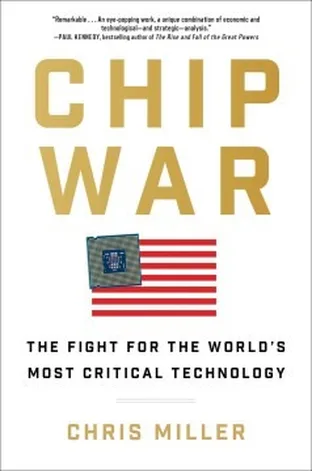
Chip War: The Fight for the World's Most Critical Technology
Decide its fate
One reader spent thirty years at Texas Instruments and Silicon Valley firms and still learned his own industry's history here: "I did not know that Taiwan's TSMC was founded by an American, Morris Chang, who had been passed over for CEO at Texas Instruments." The book runs on details like that, boardroom grudges and government seed money behind the machines, and the machines get their due too: ASML's EUV device is "arguably the most complex machine tool ever created by humans." Even the trivia travels, the sort readers pass along afterward: "Sony being co-founded by a 16th generation scion of a sake brewery." And all of it hangs off one number: "Taiwan produces 60% of the world's semiconductors, and 90% of the advanced chips."
"Why should we criticize China's heavy investment in their tech sector when the US did the same thing in the 60s-80s, when the Pentagon shoveled billions into the chip industry for the express purpose of improving missile accuracy?" one reader asks, and the book never answers: subsidies count as strategy when Washington writes the check and as menace when Beijing does. The storytelling does not carry you past the politics either. The chronology keeps rewinding, "like 30 levels of inception that you have to keep in mind to remember who did what when," and the crowd of engineers and executives becomes "an interminable conveyor belt of barely-coherent technical jargon, indistinguishable characters, and their origin stories." A reader who gave up: "this isn't a book, it's a wikipedia page."