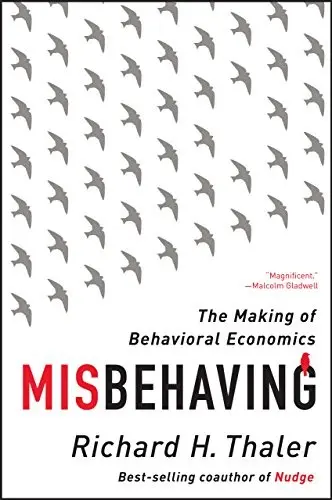
Misbehaving: The Making of Behavioral Economics
Nobel laureate Thaler tells the intellectual history of behavioral economics: how he fought the economics establishment to prove humans are not rational actors. Surprisingly funny for a book about academic warfare, it reads more like a memoir than a textbook. His concept of 'nudges' changed policy worldwide, and his proof that mental accounting distorts financial decisions changed investing.
Readers expecting a concepts-first primer on behavioral economics find the book spends more time on the history and politics of the field’s founding than on the ideas themselves. A recurring complaint calls him “a bit of a braggart,” with name-dropping and score-settling some readers flag as “childish sniping at academic opponents.” Others argue Thaler overstates his individual role and undersells how much of the underlying psychology traces back to Kahneman and Tversky’s earlier work, and say the rational-choice economists who disagreed with him get painted as “stubborn silly one dimensional characters” rather than serious opponents. One reader dismisses the whole project as a “parasitic, negative attack on the classical models.” A more technical gripe: mental accounting is presented without a testable, falsifiable form, which bothers readers with a scientific bent.
The case for it and the rest of the canon open with Pro.