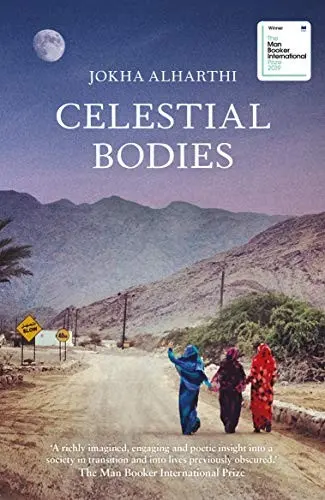
Celestial Bodies
Three sisters in a small Omani village across generations. The first Omani novel and first Arabic novel to win the International Booker Prize. Alharthi writes about slavery, tradition, and women's internal lives with such precision that the translation paradoxically shines. It opened a door for Arabic literature in English.
The constant switching between an unnamed narrator and Abdallah’s first-person chapters, plus a large cast introduced out of order, leaves readers checking the printed family tree repeatedly and still losing track; a critic calls it “impossible to follow the story without regular glances at the family tree.” Some readers say there’s barely any plot, just loosely connected sketches waiting for a conflict that never arrives; one sums it up as “not much of a plot and disparate stories.” Several give up early, in the 40 to 50 page range, before the pieces connect. Despite its short length, some say it took far longer than expected, one admitting they “forced myself through this book, taking 11 days to read” it. A critic flags the romantic and family-secret plotlines tipping into “soapy melodramas that border on pulp,” an odd clash against the novel’s more serious material.
The case for it and the rest of the canon open with Pro.