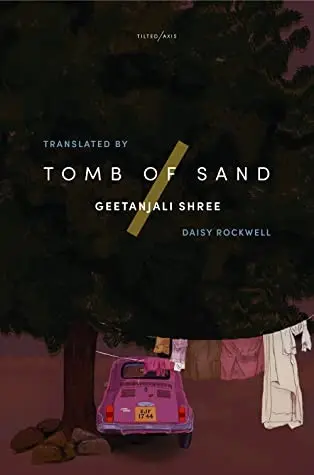
Tomb of Sand
An 80-year-old Indian woman loses herself after her husband's death, then finds herself again in ways that encompass partition, gender, and liberation. Shree's novel is formally wild, mixing registers, tones, and languages. It became the first Hindi novel to win the International Booker Prize; a long-overdue recognition.
The eighty-year-old widow stays bedridden and largely inert for roughly the first 190 to 200 pages, and readers who stall out say this is exactly where they stopped. The length draws the sharpest complaint: one reviewer says they “never read a 700+ page novel that could’ve been edited down” quite like this one, and another argues it could “be 250 pages and have all the good chunks remaining.” The narrator’s playful, childlike register wins fans over but grates on others, with one writing the voice is “child-like in a manner I found consistently cloying.” A cluster of low-star reviews describe “such haphazardly structured content and a strong disconnect with the characters,” reporting they never connected to anyone underneath the stream-of-consciousness style. Even Kirkus’s professional review echoes the reader complaint about length, flagging stretches that turn repetitive and moments where the playfulness tips into didacticism.
The case for it and the rest of the canon open with Pro.