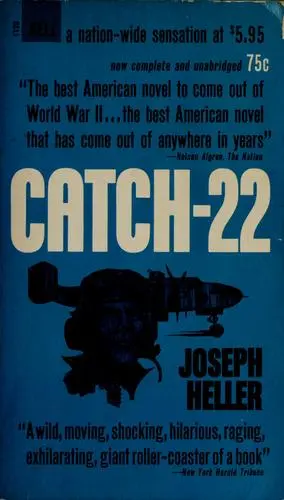
Catch-22
Decide its fate
The record
Time
An eveningA season463 pages, about 9 hours: the length of 1.4 typical books on the shelf.
Getting in
Walk right inSteep climbThree readers report quitting or struggling within the first 150 pages, the earliest at page 51.
What it gives
Plot and actionIdeas to live byIn 12 reviews from critics and book blogs, 4 credit the plot and 10 credit the ideas or a change in how they live.
One of a kind
Others do thisNothing else doesThe Book Habit blog calls it reminiscent of Vonnegut’s Slaughterhouse-Five, on the shelf at 275 pages.
The case for it
on the hospital chapter
“most explicitly in the chapter about the soldier who “sees everything twice.””
Ron Rosenbaum · Slate, 2011 on the prose
“One could read Catch-22 for its prose alone.”
a book blog on Milo Minderbinder
“Oddly one can’t help liking Milo, everyone does.”
four stars · a book blog on Milo’s persistence
“This line struck me as the key to making sense of this whole insane book.”
a Substack review
The case against
on the writing style
“The writing style is sooooo overwritten, so over polished.”
one star · a book blog on the characters
“This book has too many characters that I can’t remember even one of them”
one star · a book blog on the female characters
“the novel is quite misogynistic. The only female characters are whores and nurses”
a book blog on the repetition
“you may find this novel hard going.”
four stars · a book blog