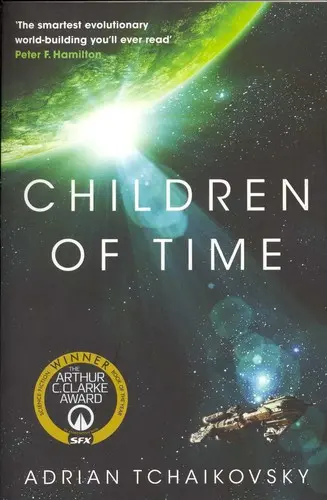
Children of Time
Spiders evolve intelligence on a terraformed world. Tchaikovsky's 2015 novel performs the unlikely feat of making arachnophobes root for Portia and her descendants across generations of accelerated evolution. Won the Arthur C. Clarke Award.
The middle reads like an evolution textbook, long exposition and thin dialogue prompting abandonments around the forty percent mark. Readers with science backgrounds push back on the label, asking “where is the hard science fiction?” and doubting “a nanovirus could transform a species directly into scientists.” The human cast is flat next to the spiders and their decisions read as contrived, sudden crew violence landing as “you start to shoot at each other, in a spaceship.” The prose is workmanlike, “distant and ‘scientific’” even about its own marvels. And the ending feels under-built.
The case for it and the rest of the canon open with Pro.