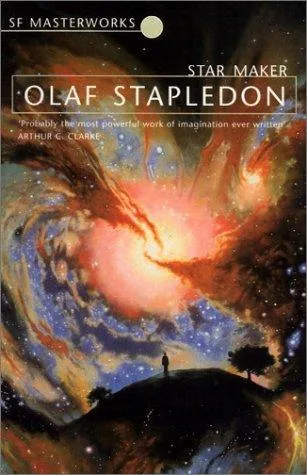
Star Maker
A man walks out of his suburban house after a quarrel and is swept off the hillside into a tour of the entire history of the cosmos: minds, species, galaxies, and at last the maker of stars itself. Written as fascism gathered in Europe, it is less a novel than a telescope aimed at everything. Borges admired it; Arthur C. Clarke called it one of the finest works of science fiction ever written.
No plot, no named characters, no dialogue in any conventional sense, just “a frame story about mental interstellar travel” narrated by a disembodied consciousness summarising civilisation after civilisation. The prose runs “page after page of descriptions, akin to old academic books,” telling and never dramatising a scene. The narrator is a blank camera with nothing to attach to across three hundred pages. The parade of new species turns numbing rather than dazzling, “another dessert planet, another icy moon,” the worlds blurring into variations. Its matter-of-fact treatment of eugenics as a tool an advanced civilisation might use reads as dated and uncomfortable now.
The case for it and the rest of the canon open with Pro.