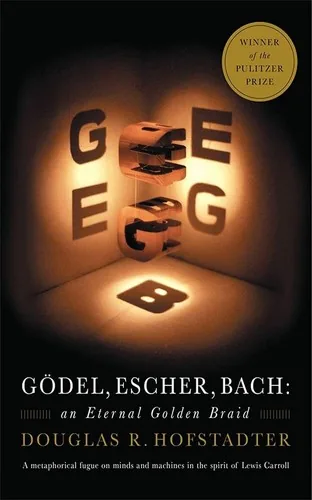
Gödel, Escher, Bach: An Eternal Golden Braid
A Pulitzer Prize-winning exploration of how meaning, minds, and a sense of "I" can emerge from meaningless formal systems, braiding Gödel's incompleteness theorem, Escher's impossible drawings, and Bach's fugues together with playful Lewis Carroll-style dialogues between Achilles and the Tortoise. Its central device is the "strange loop": a self-referential feedback structure Hofstadter argues underlies consciousness itself.
The dialogues are the problem, not the charm. One reader "skipped all of the Achilles & the Tortoise sections and became quite frustrated at how many page turns it took to contain any given idea," which is how a finisher arrives at "it would have made a good 15 page pamphlet. The rest is turgid verbiage." What fills the space in between is showing off, "overly lengthy babblings of a self-important graduate student who is way too impressed with himself," plus AI chapters stuck in 1979 that even admirers say need rewriting. No wonder so few get to the end: "Like most people that start it, I didn't finish. It is a notoriously underfinished book."
The case for it and the rest of the canon open with Pro.