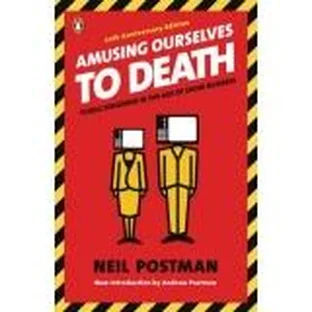
Amusing Ourselves to Death: Public Discourse in the Age of Show Business
Decide its fate
Start with the two dystopias: Orwell's, where they ban books, and Huxley's, where nobody wants one. Admirers keep reproducing that opening contrast whole; one calls it "the quote that got me to read this book." The history is checkable: crowds in 1858 stood through seven hours of Lincoln and Douglas, and now "we are not even prepared to send seven minutes on issues of real import." When Nixon met Kennedy, those who "listened to the debate on the radio fingered Nixon as the clear winner"; the screen picked the other man. The televangelism chapter, where the preacher becomes the star and God the guest, struck one admirer as "worth the cost of the book alone." All of it in 184 pages readers in 2025 apply straight to their feeds.
The whole argument leans on a clean split, truthful print versus lying image, and it cracks the first time you remember a pamphlet or a propaganda tract: "Writing, by its very nature is the manipulation of text to support one's views." His prize exhibit betrays him too, because "the Lincoln-Douglass debates were a show as he describes them," political theater a century before the camera. Meanwhile the advertiser money that actually dumbed programming down gets barely a nod, though one detractor insists "This should have been the CENTER of his argument." What remains is asserted rather than demonstrated, the exact failure he pins on television, and another finds the book itself starting to "fall more into entertainment than education."