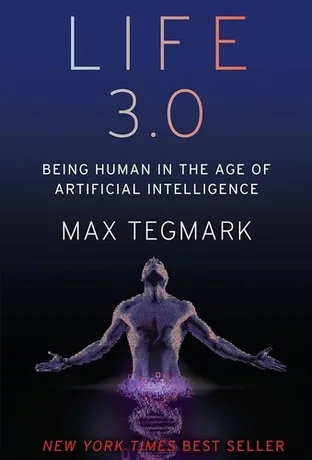
Life 3.0: Being Human in the Age of Artificial Intelligence
Decide its fate
A narrow AI called Prometheus is quietly amassing money and political power before chapter one even starts, and the book earns that opening scene. Tegmark comes at intelligence from cosmology rather than from inside an AI lab, so a goal becomes something physics can define, "dissipation-driven adaptation," a framing no computer scientist would have reached for. Readers send each other to one spot by name: "read the chapter on Goal Alignment (Chapter 7)," the practical center beneath twelve futures running from benevolent overseer to extinction. A critic calls it "One of the very best overviews of the arguments around artificial intelligence," and even a reviewer with real reservations grants that whether life gets to "flourish for billions or trillions of years" may hinge on choices being made right now.
For a book about artificial intelligence there is "almost zero technical coverage of AI," a complaint two readers filed independently a year apart: you finish still not knowing how a neural network learns. What fills the space is a roll call of famous researchers, "So much name-dropping...it seems like a secondary literature review," and the far-future stretches (Dyson spheres, matter rebuilt atom by atom) left one book-club member convinced "he was just showing off how smart he is." Tegmark's actual proposal, the Asilomar Principles, came out of a conference his own institute ran, and readers rank them with unenforceable UN declarations. And the book's central program, researching how to control superintelligence, "sits awkwardly beside his acknowledgment that controlling such godlike entities will be almost impossible," one critic writes.