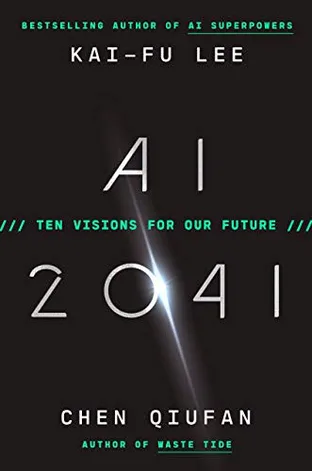
AI 2041: Ten Visions for Our Future
Decide its fate
Each chapter is locked to one technology: deep learning in Mumbai, autonomous cars in Sri Lanka, quantum computing in Munich. One critic calls the collection "rigorously disciplined in its focus," and the discipline is what makes the format teach: Chen's story dramatizes the machine first, then Lee's essay explains it, so the pairing "brings to life complex AI topics and hotly debated points" instead of lecturing. The Seoul chapter, an AI tutor raising orphaned twins, shows the hopeful ceiling: "the AI and the child had a symbiotic relationship, with one learning from the other." The closing Australian story leaves the idea that sticks, that "every economic theory is based on the assumption of scarcity," and an economy of AI plenty would need new rules written from scratch.
Whenever a plot needs a fact, the same crowbar appears: "Rather than subtly setting up a device or conceit, the author would just add 'Luckily, Bob remembered that....' before throwing in the needed element." The stories exist to hit assigned talking points, reminding one reader of Soviet literature, "where writers of small talent wrote more for the cause of building socialism than to deliver great storytelling." The cause here is a sale: Lee, a venture capitalist, rates his scenarios 80 percent likely, and a critic concludes "a selling point is exactly what is being made here." The map obeys the pitch. Surveillance dystopias happen in other countries' futures while both authors live in China, and "There's no mention of the current use of AI to control the population there."