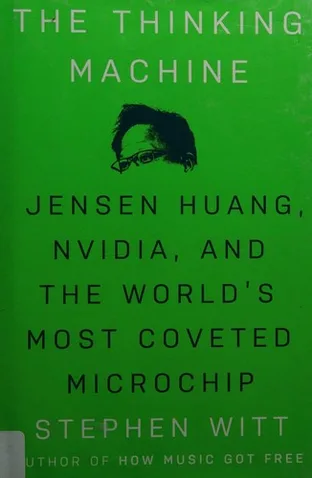
The Thinking Machine: Jensen Huang, Nvidia, and the World's Most Coveted Microchip
Decide its fate
Start with the accident: CUDA, a platform built for video gamers, sitting ready years before AI needed it. That luck, "quiet forks in history," a "sequence of fortunate collisions," is the spine of the book, and the CUDA backstory gives Witt his best pages: parallel computing and GPU architecture explained so a non-engineer can actually follow them. The arc runs from a Denny's busboy job through two 90 percent stock collapses to the most coveted chip on earth, a story "which is also the history of AI development," as one reader has it. Witt is no courtier: he presses Huang on AI risk until, in their final session, Huang turns on him. The result, one critic writes, is "one of the clearest business narratives of the AI era."
One paragraph. That is all this book spares for the monopoly question in a study of the most important company in AI. Huang's habit of humiliating employees in public gets noted and waved past, even after he turns that same temper on Witt in their final interview, which should have been the moment the reporting bit down. Instead, "Every questionable move is retrofitted as wisdom because it worked." His wife's abandoned engineering career surfaces once and vanishes. His answers on AGI are the same rehearsed lines he hands every interviewer, and the closing chapter on AI risk feels stapled on. It "reads more like a tribute than an analysis," one detractor writes, "an uncritical glorification of the 'visionary CEO.'" After all that reporting, "we never learn who Huang really is."