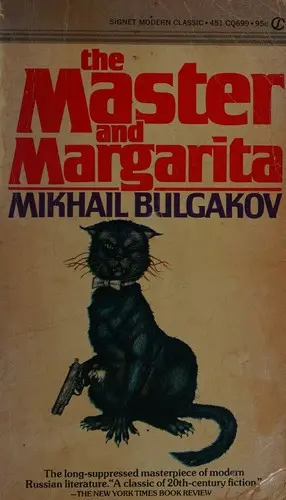
The Master and Margarita
Decide its fate
The record
Time
An eveningA season386 pages, about 8 hours: the length of 1.2 typical books on the shelf.
Getting in
Walk right inSteep climbThree readers describe a slow or confusing start before Margarita’s story begins, one stopping after 100 pages.
What it gives
Plot and actionIdeas to live byIn 14 reviews from critics and book blogs, 5 credit the plot and 10 credit the ideas or a change in how they live.
One of a kind
Others do thisNothing else doesThree reviewers point to Goethe’s Faust, the source of the book’s epigraph and on the shelf at 306 pages.
The case for it
on Behemoth the cat
“very much liked Behemoth, often referred to as the large black cat.”
a book blog on Woland’s morality
“not a one-dimensional villain but a symbol of justice and balance”
a book blog on the prose style
“the writing style feels so contemporary; rich, yet easy to read.”
a book blog on the genre blend
“equal parts parody, parable, absurdism, horror, and sci-fi”
Raymond De Luca · Los Angeles Review of Books, 2024
The case against
on the complex sentences
“hard to get into the flow of the book initially because of the complex sentences”
a book blog on the character names
“keep up with the numerous important characters in the story due to their names”
five stars · a book blog on the Master
“The Master is a fairly undeveloped character. We don’t learn his real name.”
four stars · a book blog on the slow scenes
“some scenes or dialogue can be slow”
a Substack review