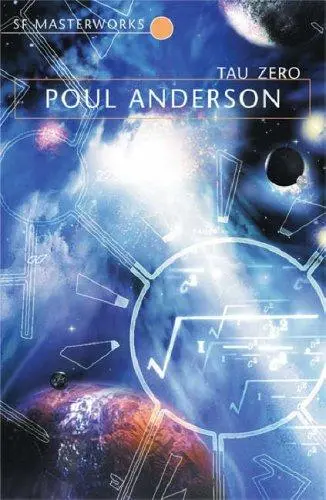
Tau Zero
A Bussard ramjet malfunctions and begins accelerating continuously. The crew must live through the entire future of the universe. Anderson's hard-SF novel is the most rigorous exploration of relativistic time dilation ever written, and the most existentially terrifying thought experiment of 1970s SF.
The crew are cardboard, types performing assigned roles rather than people. The treatment of the twenty-five women aboard is the recurring sore point, scenes where they exist mainly to manage men’s moods and get described by their bodies, which reads as regressive rather than merely dated. The opening drags through technical exposition before the damage that starts the plot. Readers with physics push back, one deciding Anderson “doesn’t understand Special Relativity very well,” and the closing cosmology leans on an oscillating universe model science has since abandoned. “The plot is more or less predictable,” settling into adapt-and-endure, and the interpersonal drama plays as soap opera.
The case for it and the rest of the canon open with Pro.