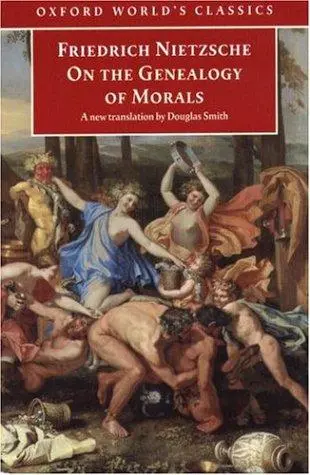
On the Genealogy of Morals
Decide its fate
The record
Time
An eveningA season208 pages, about 4 hours: two-thirds the length of a typical book on the shelf.
Getting in
Walk right inSteep climbThe preface explains Nietzsche’s method, then the first essay traces ‘good’ and ‘bad’ to aristocratic and priestly word roots.
What it gives
Plot and actionIdeas to live byIn 10 reviews from critics and book blogs, none credit the plot and 10 credit the ideas or a change in how they live.
One of a kind
Others do thisNothing else doesMencken’s 1913 reading order and a 1999 Satirist essay both place it as the follow-up to Beyond Good and Evil.
The case for it
on the ascetic ideal
“This work is perhaps the least aphoristic, in form, of all Nietzsche’s productions. For analytical power, more especially in those parts where Nietzsche examines the ascetic ideal, The Genealogy of Morals is unequalled by any other of his works; and, in the light which it throws upon the attitude of the ecclesiast to the man of resentment and misfortune, it is one of the most valuable contributions to sacerdotal psychology.”
Oscar Levy · Editor's Note, The Genealogy of Morals, 1913 on his ideas
“a lot of his ideas really started falling into place for me”
a Substack review on its influence
“an influential philosopher who challenged how we thought about ideas”
a Substack review on the morality of pity
“Nietzsche was perhaps the 1st to detect something that would become ferocious, omnipresent, and suffocating”
a Substack review
The case against
on the argument
“I found Nietzsche’s style of argumentation to be very difficult to follow”
three stars · a book blog on the style
“Particularly off-kilter is his writing style: at times aphoristic, self- conscious, affronting”
a book blog on the difficulty
“many readers feel lost in the whirlpool of his ideas”
Dan Geddes · The Satirist, 1999 on the priestly caste
“Nietzsche is clearly being too racist and patronising”
a book blog