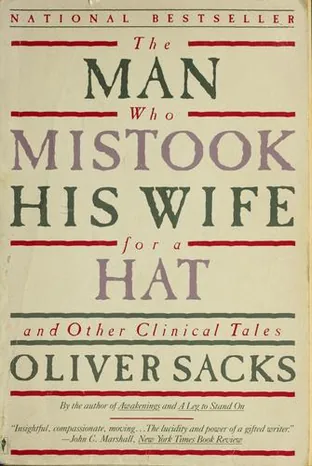
The Man Who Mistook His Wife for a Hat
A collection of twenty-four clinical tales by neurologist Oliver Sacks, told as human stories rather than case files, each portraying a patient living with a strange neurological condition: the title case's visual agnosia, lost memory, phantom limbs, savant gifts. First published 1985 (Summit Books US / Duckworth UK), it became one of the best-selling works of popular medical writing.
There is a sentence on page 112 that one detractor read "at least twelve times, and I still don't even have the slightest inkling of what the hell it means," and it has plenty of company: hyperagnosia, Korsokovian, meningioma, none of it translated. Survive the vocabulary and the science never arrives: "He talks about phenomenology, but doesn't satisfactorily discuss mechanistically what is going on in the brain, so what's the point?" Even the famous warmth can curdle. One reader felt "whisked in and out of hospital rooms by a busy, clipboard-toting doctor," rounds run by a man more taken with the disorder than the person inside it. And current printings still carry the 1985 vocabulary: "retardates, defectives, idiots, morons, simpletons."
The case for it and the rest of the canon open with Pro.