The Last Book Shelf
Download
canon · AI & Technology
AI & Technology
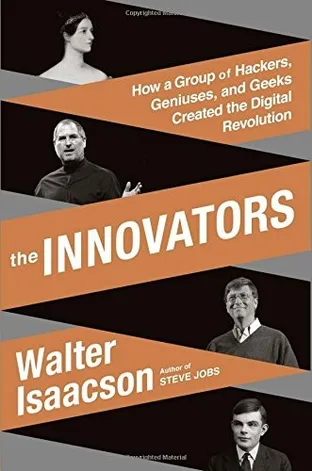
Cover of The Innovators: How a Group of Hackers, Geniuses, and Geeks Created the Digital Revolution by Walter Isaacson

The Innovators: How a Group of Hackers, Geniuses, and Geeks Created the Digital Revolution

Walter Isaacson
2014
Following his Steve Jobs biography, Walter Isaacson traces the people who built the computer and the internet, from Ada Lovelace's 1840s notes on programmable computing through ENIAC, the transistor, the personal computer, and the web.

Decide its fate

The case for it
The recovered history is the draw. Ada Lovelace working out programmable computing in the 1840s, Vannevar Bush describing linked, searchable archives in 1945 ("He even predicted hypertext!" one reader exclaims), and above all the women who programmed the military's first machines. "I was especially glad that Isaacson gave the female programmers the attention they deserved," an admirer writes; another reader, years later and unprompted, walks away with the same fact, that "the earliest computer programmers for the military computers during WW2 were women." The chapters send people off the page: one reader stopped mid-chapter and "spent an entire Saturday online learning about the basic physics and chemistry involved in that process." And between the transistor and the microchip, the book gives Pong most of a chapter.
real-reader reviews (AI wing, 2026-08)
The case against
Traced backward from what won: "a history of innovation from the point of view of the winners," a detractor calls it. Jef Raskin, who originated the Macintosh concept, gets a single mention. Ted Nelson, barely there. "The Gopher protocol, which predates the web, was extremely important, and, arguably, would have been more useful for certain kinds of information browsing," but Gopher lost, so out it goes. Even among winners: "Atanasoff (who never got his machine to work) was given more than three times as much page time as Konrad Zuse, who built the world's first programmable computer." Then the teams thesis, hammered for 500 pages, splits into three kinds at the end: "Sorry, you can't have your lumping claim, and then at the end of the book break it down."

the honest librarian
11h
honest hours
16
sittings
beyond the verdict
if you loved this, read these →
Cover of Atlas of AI: Power, Politics, and the Planetary Costs of Artificial Intelligence by Kate Crawford
Atlas of AI: Power, Politics, and the Planetary Costs of Artificial Intelligence
Kate Crawford
Cover of The Coming Wave: Technology, Power, and the 21st Century's Greatest Dilemma by Mustafa Suleyman
The Coming Wave: Technology, Power, and the 21st Century's Greatest Dilemma
Mustafa Suleyman
Cover of Unmasking AI: My Mission to Protect What Is Human in a World of Machines by Joy Buolamwini
Unmasking AI: My Mission to Protect What Is Human in a World of Machines
Joy Buolamwini
Cover of The Worlds I See: Curiosity, Exploration, and Discovery at the Dawn of AI by Fei-Fei Li
The Worlds I See: Curiosity, Exploration, and Discovery at the Dawn of AI
Fei-Fei Li
Cover of Guardrails: Guiding Human Decisions in the Age of AI by Urs Gasser & Viktor Mayer-Schönberger
Guardrails: Guiding Human Decisions in the Age of AI
Urs Gasser & Viktor Mayer-Schönberger
Cover of AI 2041: Ten Visions for Our Future by Kai-Fu Lee & Chen Qiufan
AI 2041: Ten Visions for Our Future
Kai-Fu Lee & Chen Qiufan