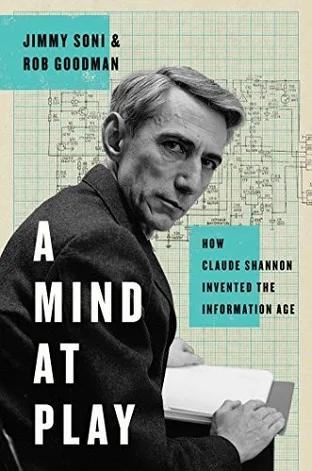
A Mind at Play: How Claude Shannon Invented the Information Age
Decide its fate
He rode a unicycle down Bell Labs hallways while juggling, built a flame-throwing trumpet, and wrote the 1948 paper the digital world runs on: "the most brilliant man you've never heard of," one admirer calls him. The authors are writers rather than engineers, and that works in the book's favor: they "have taught themselves the mathematics they need to explain Shannon's work," so basic algebra gets you through the formulas, and a reader who arrived already knowing the communications theory left with a whole second career, genetics, wartime cryptography, computer chess, wearable computers ("Written by non-technical authors, but they obviously did their homework"). One listener adds: "since I listened to the digital audiobook version of the book, I used his work in reading it."
Come for the information theory and you get a sliver, one reader putting the part he came for at a tenth of the book, the rest "a tedious recounting of what institutions and universities he worked at, who his acquaintances were." An audiobook listener ran the same math: "Only 50% of the content is actually ABOUT Shannon," with room found for the life story of a jazz singer. A reader with MIT and Bell Labs years says it confuses sampling with coding, and asks: "Soni and Goodman are speechwriters with a background in political science. Why would we expect them to understand information theory." The slips reach past the math: "The authors also confuse Beethoven with Mozart, calling the former a child prodigy pushed by his father."