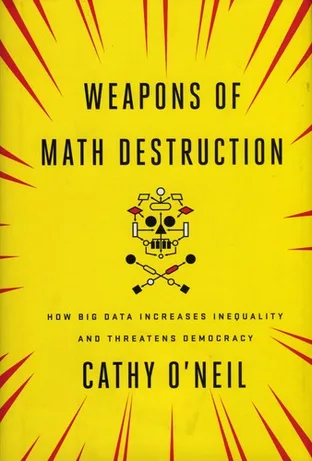
Weapons of Math Destruction: How Big Data Increases Inequality and Threatens Democracy
Decide its fate
The people best placed to call this book alarmist keep vouching for it instead. One former predictive modeler writes that the tactics documented here are the same ones that drove him out of the industry: "More people should be outraged. This book could help." A reviewer with modeling research of his own says, "I can't stress how important of a book this is." O'Neil ran hedge-fund models through the 2008 crash before turning on them, and her test for algorithms that are "obscure, unfair and grow exponentially" proves portable: readers apply it to dating sites the book never covers. The Facebook chapter went to press in September 2016, before that election's scandals broke, describing machinery still "unseen and unaccountable."
Here is the bait and switch: a Harvard math PhD promising to expose the algorithms, then never opening one up. A working data scientist found no in-text footnotes and calls the result "a very surface level essay without the deeper exploration"; the case studies come secondhand from newspaper reporting. Her own test gets a thumb on the scale, human bias forgiven because it evolves while machine bias is damned, and one reviewer concludes, "For the most part, WMD is a rant with only impractical statements as solutions." The fixes, crammed into roughly fifteen pages, amount to a Hippocratic oath recycled "from twenty years and two big economic recessions ago." Even a reader who recommends the book concedes it is "very preachy, and very liberal."