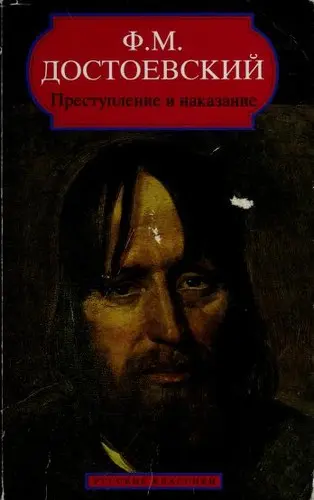
Crime and Punishment
Decide its fate
The record
Time
An eveningA season551 pages, about 11 hours: the length of 1.7 typical books on the shelf.
Getting in
Walk right inSteep climbTwo readers report stalling at chapter one; the murder that opens the plot happens at the end of Part One.
One of a kind
Others do thisNothing else doesReaders on three blogs name The Brothers Karamazov (867 pages) as preferred, and one names Notes from Underground (240 pages) instead.
The case for it
on the characters
“To such I suppose the book may seem empty in the centre; to the others it is a room, a house of life, into which they themselves enter, and are tortured and purified. The Juge d’Instruction I thought a wonderful, weird, touching, ingenious creation: the drunken father, and Sonia, and the student friend, and the uncircumscribed, protaplasmic humanity of Raskolnikoff, all upon a level that filled me with wonder: the execution also, superb in places.”
Robert Louis Stevenson · letter to John Addington Symonds, spring 1886 on the gospel reading
“the prostitute and the murderer are reading and discussing John 11”
a Substack review on Porfiry’s interrogation
“the verbal duel between Raskolnikov and Porfiriy Petrovich (the investigator) was absolutely brilliant”
a book blog on Raskolnikov’s mind
“almost felt to me as if I was sitting inside the mind of a killer”
a Substack review
The case against
on the drinking and hysteria
“Hysteria! Drink! Hysteria! Drink! Hysteria! Drink!”
two stars · a book blog on the audiobook length
“The audiobook of Crime and Punishment is 22 hours long. It felt like more.”
three stars · a book blog on the character names
“the names are so similar that it is extremely tedious and difficult for the reader”
one star · an Amazon review on the writing style
“could have been promising, if not for the story telling, the writing style”
one star · an Amazon review