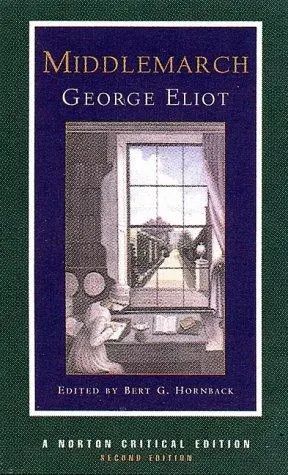
Middlemarch
Decide its fate
The record
Time
An eveningA season880 pages, about 18 hours: the length of 2.8 typical books on the shelf.
Getting in
Walk right inSteep climbFour readers report stalling in the opening chapters, one of them quitting after 50 pages.
One of a kind
Others do thisNothing else doesA reading list and two forum threads group it with Anna Karenina, 838 pages, and Bleak House, 815 pages.
The case for it
on grown-up readers
“But to the reader who holds a large stretch of her early work in view it will become obvious that the mist of recollection gradually withdraws. It is not that her power diminishes, for, to our thinking, it is at its highest in the mature Middlemarch, the magnificent book which with all its imperfections is one of the few English novels written for grown-up people.”
Virginia Woolf · ‘George Eliot,’ The Times Literary Supplement, 20 November 1919 on Eliot’s wit
“How can you not love a writer who skewers her characters as neatly as that?”
a book blog on the construction
“a novel of intense, dedicated craftsmanship, of construction so intricate and careful”
five stars · a book blog on chapter one
“the wonderful Chapter 1, which reads like a Jane Austen novel.”
a Substack review
The case against
on the structure
“Middlemarch is a treasure-house of details, but it is an indifferent whole. Our objection may seem shallow and pedantic, and may even be represented as a complaint that we have had the less given us rather than the more.”
Henry James · unsigned review, The Galaxy, March 1873 on Dorothea Brooke
“But nowadays she strikes me as a blue-stocking bore”
Theo Hobson · The Spectator Australia, 2026 on the character names
“I confused a lot of the characters because everyone’s name begins with F.”
two stars · a book blog on the first half
“the first half of this book felt like the reading equivalent of running through custard”
a Substack review